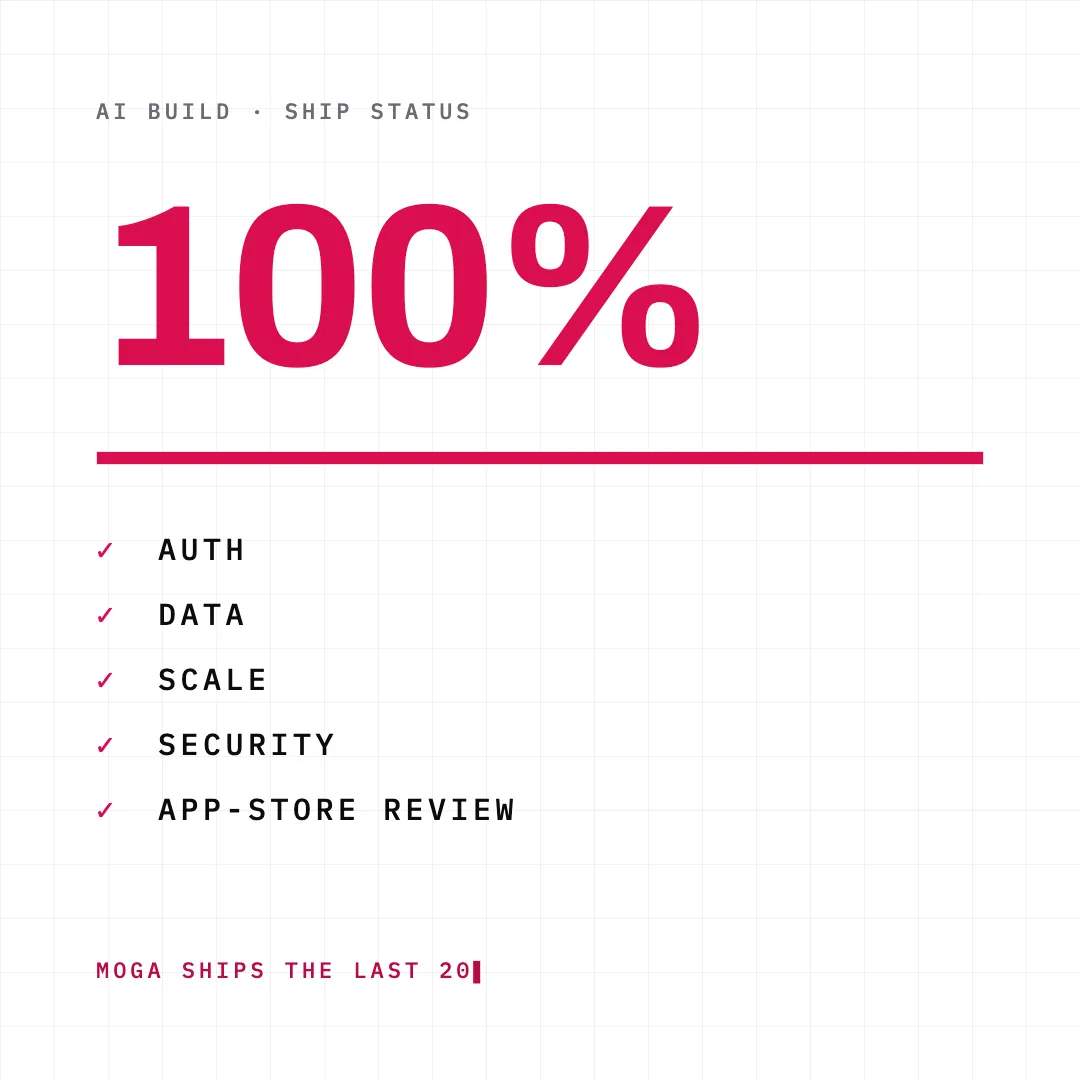
AI built your app 80% of the way. We ship the last 20.
The prototype was the easy part. No shame in that; prototypes are supposed to be easy. Production is auth, data, scale, security, and app-store review. That's where we come in.
Where AI-built apps break
Security
Demos skip auth flows, secrets, and input validation. Attackers don't.
Data
Schemas that fight every new feature. Migrations, backups, and integrity nobody wired up.
Scale & cost
What happens at 1,000 users, and what it does to your cloud bill.
Shipping
App-store review, monitoring, crash reporting, updates. Distribution is a discipline.
How rescue works
Assessment
Fixed-scope code and architecture review. A written report: what is sound, what is fragile, what it takes to ship. No obligation beyond it.
Rescue
We complete and harden your app to production quality: security, data, performance, deployment, store submission. Scoped from the assessment.
Partner
Ongoing senior engineering after launch: features, scaling, and the operational care a real product needs.
From first email to handover
You send the app
A repo link, a live URL, or a TestFlight build, plus a few sentences on where you're stuck. Happy to work under a mutual NDA; say the word.
Assessment
A principal runs the app, reads the code hands-on, and maps what stands between the demo and production. About a week, fixed price.
The decision
We walk you through the findings on a call and hand over a firm quote for the rescue. If a rebuild or a simpler path is the right answer, this is where we say so.
The rescue
Work lands in week-sized chunks, each ending in something you can run. It all happens in your own repo, as real pull requests — every change explained in plain English, so you understand what you own.
Handover
You get the code, the infrastructure, the docs, and a walkthrough. The measure of success is simple: your next engineer can pick the system up cold.
A typical rescue
A composite of recent engagements, details changed to protect the founders. Someone builds a booking platform with an AI tool and gets far enough to demo it to investors. Under the surface: passwords hashed with a homemade function, every authorization check living in the React layer, and customer records duplicated across three tables with no migrations and no backups.
The UI and most of the data model were sound, so they stayed. We rebuilt authentication and the API boundary, consolidated the schema and put real migrations in place, then took the app through load testing and store submission. About six weeks of part-time senior work.
Why trust us with it
We ship our own products and rescue enterprise codebases for a living. Alumni of Rightpoint & Valtech.
- Since 2015
- 40+ projects shipped
- 50 years combined experience
- Alumni of Rightpoint & Valtech
When you don't need us
If the project is a marketing site or a landing page, use a website builder. That problem was solved years ago, and paying senior engineers for it is waste.
If the idea isn't validated yet, keep going with the AI tools. A working demo is often enough to learn whether anyone wants the thing. Spend on real engineering when the idea has earned it.
And if an assessment finds your codebase is sound, you pay for the report and ship it yourself. We'd rather be right than be billable.
Common questions
9 questionsCan you finish an app I built with AI tools like Cursor, Bolt, or Lovable?
Yes. That is exactly what AI Rescue is: we take AI-generated codebases to production quality. We assess what you have, keep what is sound, and harden or replace what is not: security, data, performance, and app-store or deployment readiness.
Will you rebuild from scratch?
Usually not. Most AI-built apps have a keepable core. A rebuild-from-zero is the last resort, not the default. If it genuinely is the cheaper path, we will tell you before you spend a dollar.
What does the assessment include?
A fixed-scope review of your codebase and architecture: security posture, data model, dependency health, performance, and deployment readiness, delivered as a written report with a prioritized plan and a firm estimate for the rescue.
What does it cost?
The assessment is fixed-price. Rescue work is scoped from the assessment, so you are never buying an open-ended engagement. Expect enterprise quality at a fraction of agency rates.
How long does a rescue take?
The assessment takes about a week. Most rescues then run four to ten weeks of part-time senior work, scoped from what the assessment finds. You see the timeline with the quote, before you commit to anything.
Which AI tools do you work with?
Cursor, Bolt, Lovable, Replit, v0, Copilot, and code pasted out of ChatGPT or Claude. The tool matters less than the state of what it produced. We start from whatever you have.
My app is already live with real users. Can you work on it without breaking things?
Yes. On live products we work in branches, ship behind feature flags where that helps, and migrate data with a rollback plan. Your users keep their uptime while the app gets its foundation.
Who owns the code when you're done?
You do, from day one. Work happens in your repository, on your infrastructure, in your cloud account, and handover includes full documentation.
My app mostly works. Do I still need this?
"Mostly works" is the most expensive phase of an app: real users find the edge cases, and prototypes rarely handle auth, scale, or data integrity safely. A short assessment now is far cheaper than an incident later.
Send us what you've built.
A principal reviews it and replies within one business day.
Get an assessment